

Shoppers do not typically buy on impulse. Even a low-cost purchase runs through a sequence of steps: recognizing a need, searching for options, comparing alternatives, committing to a choice, and then judging whether that choice was right. This is the consumer decision-making process. For eCommerce retailers, understanding each stage is the difference between a conversion and a bounced session.
Consumer decision marketing framework was formalized by Philip Kotler and has five stages: need recognition, information search, evaluation of alternatives, purchase decision, and post-purchase behavior. Each stage is a point where a shopper can leave. The retailer’s job is to remove the reasons to leave.
This guide covers what happens at each stage of the consumer decision-making process, where shoppers most commonly stall, and five practical steps eCommerce teams use to keep decision momentum moving. For the latest data on how shoppers are making informed purchase decisions in 2026 specifically, see our companion piece: Helping Shoppers Make Informed Purchase Decisions in 2026.
What is the consumer decision-making process?
The consumer decision-making process describes the steps a buyer takes from recognizing a need to completing a purchase. Philip Kotler’s widely cited model identifies five stages: need recognition, information search, evaluation of alternatives, purchase decision, and post-purchase behavior.
In eCommerce, these stages are compressed. A shopper can move from discovering a product to checking out in minutes. But the stages are not removed: they are accelerated, and friction at any point still causes abandonment.
The average cart abandonment rate across eCommerce is around 70%, For a detailed breakdown of what causes abandonment at the purchase stage, see how to reduce cart abandonment and what causes it.
Understanding where in the decision process shoppers stall gives retailers a targeted way to address the right problem.
Philip Kotler’s five stages of the consumer decision-making process:
- Need recognition: the shopper becomes aware of a gap between their current state and a desired state. This can be triggered by advertising, a recommendation, or a life event.
- Information search: the shopper looks for products that address the need. This includes search engines, review platforms, social media, and product listing pages.
- Evaluation of alternatives: the shopper compares options. This is the stage where product detail pages, reviews, and social proof signals carry the most weight.
- Purchase decision: the shopper commits. At this point, trust signals, price, delivery terms, and checkout friction determine whether they complete.
- Post-purchase behavior: the shopper evaluates whether the purchase met expectations. Positive outcomes generate reviews; negative outcomes generate returns and churn.
Why eCommerce retailers lose shoppers at each stage
At the information search stage, the majority of shoppers consult reviews before they buy — around nine in ten, by most industry estimates. Shoppers who cannot find credible product information move to a competitor who provides it.
At the evaluation stage, decision paralysis on product listing pages is a documented conversion barrier: too many options without clear differentiation causes shoppers to abandon rather than choose.
At the purchase stage, unexpected extra costs are the single biggest driver of abandonment, followed by forced account creation and concerns about payment security.
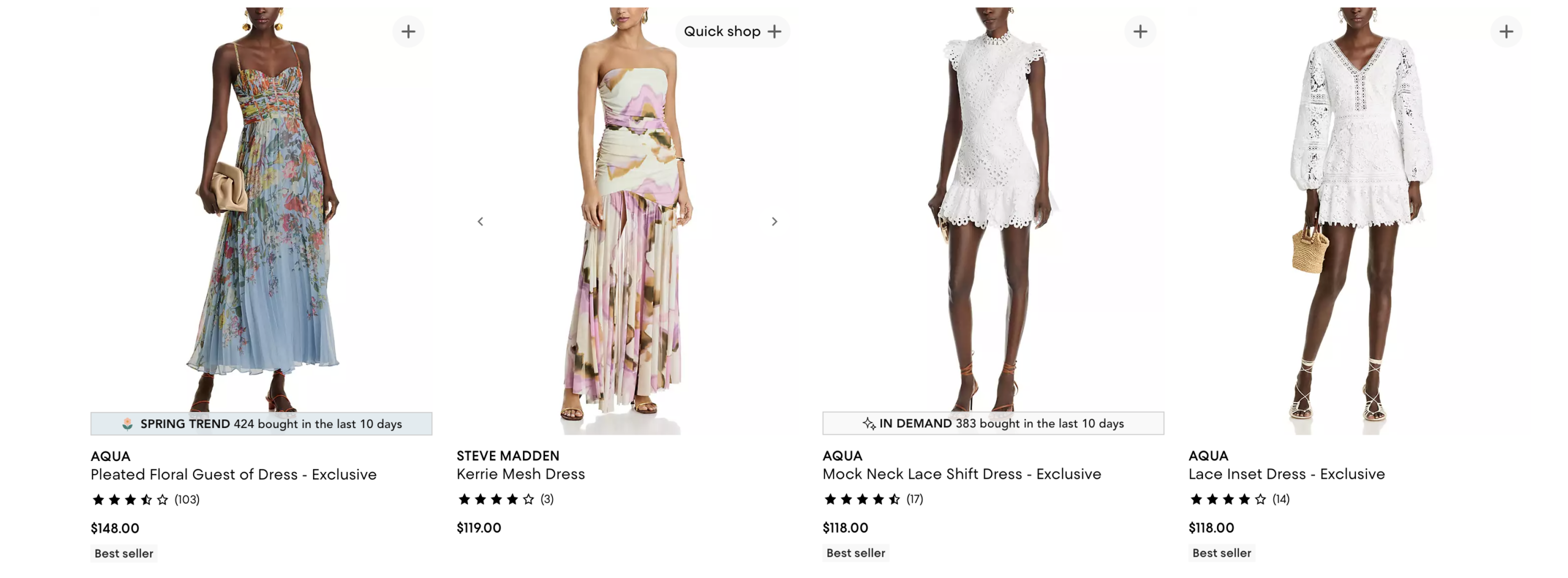
For Social Proof Messaging, the evaluation stage is where real-time data makes the clearest difference. A message such as “47 people are viewing this” or “Bestseller in the past 24 hours” on a product detail page answers the shopper’s core question — is this the right choice? — with real behavior from real shoppers, and no manufactured urgency. Brands like Steve Madden use Taggstar’s Social Proof Messaging to reduce evaluation-stage hesitation, resulting in 5.41% conversion rate uplifts.
Step 1: Use customer reviews to support the information search stage
Customer product reviews play a critical role in helping shoppers make more informed decisions, giving authentic, first-hand insight into a product’s performance, quality and value. Because reviews carry both pros and cons from real customers, shoppers trust them more than marketing copy.
According to a 2025 survey by PowerReviews by Syndigo on the growing influence of product reviews, 95% of consumers surveyed said they regularly read product reviews as part of their shopping journey and 96% said that ratings and reviews were the most influential factor in their purchase decisions.
Reviews have become table stakes. Larger retailers may hold hundreds or thousands of reviews for a single product, so the challenge now is helping shoppers surface the relevant ones quickly, in a sea of data.
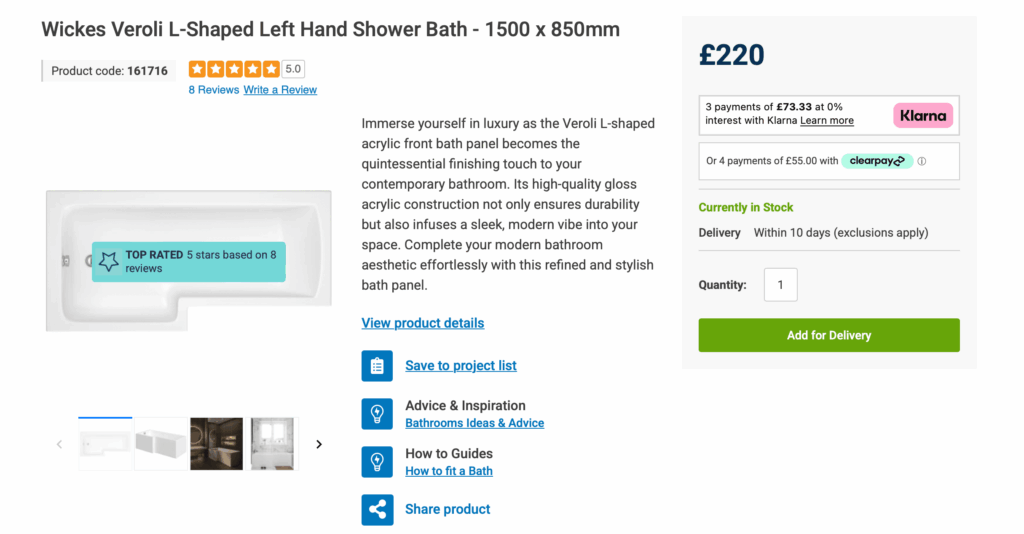
By pairing aggregated review data with Social Proof Messaging, retailers combine two proven conversion strategies and bring the most relevant information front and center. Home improvement and DYI retailer Wickes integrated review messaging from PowerReviews by Syndigo with social proof messaging and immediately boosted conversion rates and drove a measurable uplift in revenue. See how Social Proof Messaging works at the evaluation stage, explore the solution
Step 2: Strengthen the information search stage with comprehensive product content
In eCommerce, where shoppers cannot touch, feel or try on a product, detailed but digestible product descriptions let them visualize it and judge whether it fits their needs.
Clear, accurate descriptions build trust, improve the experience, and help customers decide with confidence. They also pre-empt the questions and concerns that drive misunderstandings and returns.
But not all product content is equal. There is a fine balance between giving shoppers enough and overwhelming them. Much of this comes down to site structure, flow and design, and the technology that surfaces the right information at the right moment.
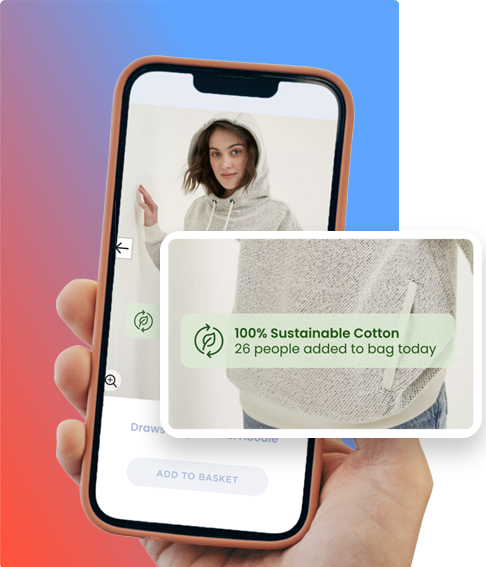
Sustainability is a good example: many shoppers actively seek out products that are environmentally friendly, yet that detail is often buried in long descriptions. Attribute Messaging on a product detail page brings key attributes such as sustainability credentials to the surface on the product detail page, so shoppers can find them and decide faster.
Step 3: Use visuals to support evaluation of alternatives
High-quality images and engaging visuals are essential to a strong online shopping experience and to confident decisions.
Good visuals give a clear view of the product — features, design and quality. Where shoppers cannot handle a product in person, images and detailed descriptions bridge the gap together.
Visuals should include multiple angles, zoom, color samples and video. Lifestyle and editorial imagery helps shoppers picture how a product fits into their lives. In categories like home and beauty, some retailers add augmented reality so shoppers can see how a product looks in their own space.
Like reviews, customer photos and videos add authentic, trustworthy detail. Most retailers let customers attach images to reviews; some feature that user-generated content directly in product descriptions to show how people like them use the product.
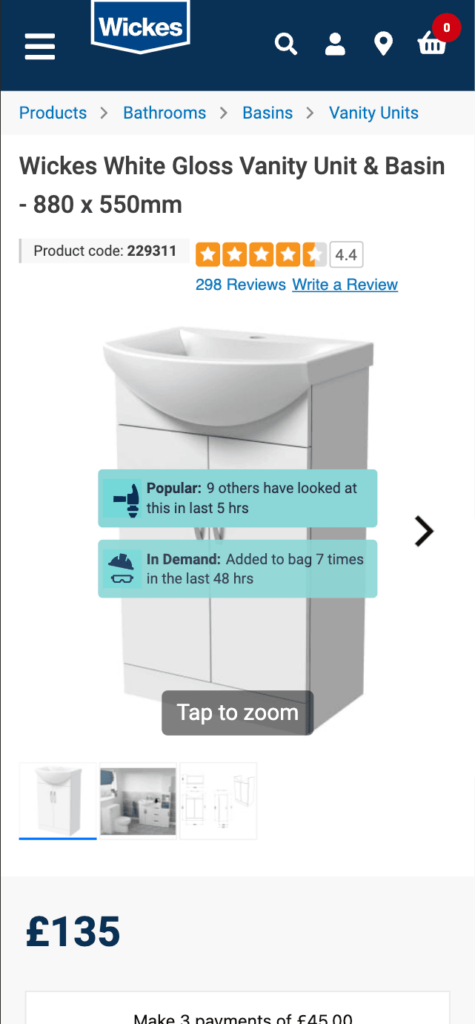
Visuals also improve product listing page design, helping shoppers find what they need faster. DIY retailer Wickes used animated Social Proof Messaging to lift engagement, surface relevant information, and build buyer confidence. By implementing animated icons, Wickes saw a 1.57% conversion rate uplift.
Step 4: Remove purchase-stage friction with transparent pricing and returns
Unclear pricing, unexpected and hidden costs and unclear return policies are among the most-cited reasons for cart abandonment.
Transparent pricing and clear delivery and return policies build trust and let shoppers commit without fear of surprises. When prices are upfront, shoppers can compare, assess value, and feel confident they are getting a fair deal — which removes one of the biggest causes of abandonment.
Clear policies also compound over time: they support informed decisions, encourage repeat business, and improve the overall experience by making shoppers feel respected.
Step 5: Use FAQs and Q&A to reduce evaluation-stage uncertainty
Well-crafted FAQ sections on eCommerce sites provide quick and accessible answers to common customer questions, reducing uncertainty and confusion. Retailers and brands should review search results, leverage keyword research and insights from customer service to help develop the FAQ section. By addressing potential concerns proactively, such as product details, return policies, shipping information, and warranty coverage, FAQs empower customers to make decisions with confidence.
FAQs also save shoppers time by reducing the need to contact a customer service representative for generic questions, reducing friction and improving the overall shopping experience.
Expert and customer Q&A sections, where customers can ask questions and get answers from real users, are becoming increasingly popular as well. Real-life scenarios from past customers and experts are more trustworthy and relatable, and helps shoppers clarify information, provide additional insights and reduce doubt.
Ultimately, well-crafted FAQs, along with Expert and Customer Q&A sections, can increase conversion rates, build trust, and enhance customer satisfaction by ensuring that shoppers have all the information they need to make a purchase.
The post-purchase stage: closing the loop
The consumer decision process does not end at the point of purchase. Post-purchase behavior feeds back into the top of the funnel: reviews from satisfied customers become the social proof that resolves evaluation-stage uncertainty for the next shopper. Retailers who treat purchase as the finish line miss this compounding effect.
Taggstar’s Social Proof Messaging works across the full decision cycle. Real-time messages on product pages turn evaluation-stage hesitation into action, and post-purchase review data feeds back into the messaging layer, keeping the social proof current and credible.
Retailers like Bloomindale’s and Hot Topic use Taggstar’s Social Proof Messaging to support each stage of the decision process. Taggstar’s optimization services ensure that messaging is tested, refined, and performing from day one.
Measuring the impact of decision-support activity
Optimizing for the consumer decision-making process means measuring at each stage, not just at conversion.
Key metrics by stage:
- Information search: organic traffic to category and detail pages, PLP bounce rate, search ranking for product-level queries.
- Evaluation: time on PDP, add-to-bag rate, scroll depth on product pages.
- Purchase decision: cart abandonment rate, checkout completion rate, payment error rate.
- Post-purchase: review submission rate, return rate, repeat purchase rate within 90 days.
Taggstar’s platform tracks conversion rate uplift and revenue per visitor (RPV) in real time, with A/B testing that isolates the impact of Social Proof Messaging from other variables. Results are attributable, not modelled. For more on Taggstar’s ongoing performance management, see our optimization services.
FAQs
What is the consumer decision-making process?
The consumer decision-making process describes the sequence of steps a buyer takes between recognizing a need and completing a purchase. Philip Kotler’s widely cited model identifies five stages: need recognition, information search, evaluation of alternatives, purchase decision, and post-purchase behavior. In eCommerce these stages are compressed into minutes, but each one still represents a point where a shopper can abandon the process.
What are the five stages of consumer decision making?
The five stages are need recognition (the shopper identifies a gap), information search (the shopper looks for solutions), evaluation of alternatives (the shopper compares options), purchase decision (the shopper commits), and post-purchase behaviour (the shopper judges whether the purchase met expectations). For eCommerce retailers, the evaluation of alternatives stage is where product content, reviews, and real-time social proof carry the most weight.
How does social proof influence the consumer decision-making process?
Social proof primarily operates at the evaluation-of-alternatives stage. When a shopper sees that 200 people have bought a product in the past 48 hours, or that it is a bestseller in its category, that real-time behavioral data reduces uncertainty and makes the choice easier to commit to. According to a 2025 survey by PowerReviews by Syndigo on the growing influence of product reviews, 96% said that ratings and reviews were the most influential factor in their purchase decisions.
What causes high cart abandonment rates in eCommerce?
The most common causes are unexpected costs at checkout (shipping, taxes), forced account creation, concerns about payment security, and a long or complicated checkout process. The Baymard Institute reports an average cart abandonment rate of 70% across eCommerce. Reducing friction at the purchase decision stage, through guest checkout, transparent pricing, and trust signals at the point of payment, directly addresses these causes.
How can eCommerce retailers measure the consumer decision-making process?
The clearest approach is to assign a measurable metric to each stage: organic traffic and bounce rate for information search; add-to-bag rate and time on the product detail page for evaluation; cart abandonment and checkout completion rate for the purchase decision. Post-purchase metrics include review submission rate and 90-day repeat purchase rate. Tracking these separately shows where the biggest drop-off occurs, which focuses optimisation effort on the right stage.
What is the difference between social proof and fake urgency in eCommerce?
Social proof uses real data from real shopper behaviour: actual view counts, purchase rates, and stock levels drawn from live platform data. Fake urgency uses inflated or manufactured figures to pressure shoppers. The distinction matters because shoppers are increasingly able to spot artificial pressure tactics, and because regulatory guidance from bodies such as the Competition and Markets Authority (CMA) requires scarcity and popularity claims to be accurate. Taggstar’s Social Proof Messaging uses only real-time, auditable data, with no manufactured scarcity signals.