

Product attributes are the details that help consumers learn about a product to make informed and confident purchase decisions.
TABLE OF CONTENT
What are product attributes? Definition and meaning
Why Product Attributes Matter in eCommerce
Different Types of Product Attributes (With Examples)
How to Use Product Attributes in eCommerce
Common Challenges with Product Attributes
Attribute Messaging: The Next Step in Optimizing eCommerce Product Pages
Product attributes can include everything from size, color, and material to less visible features such as sustainability or intangible benefits such as suitability. In retail and eCommerce, product attributes play a critical role in helping shoppers find, understand, and choose products that meet their needs.
For eCommerce marketers and merchandisers, attributes are necessary to create effective product pages, enhance search and filtering, and increase conversions by highlighting key product information throughout the customer journey. For brands and retailers with large and fast-changing product catalogs, managing attributes can be resource-intensive and overwhelming.
Fortunately, there are technology platforms that help retailers improve the efficiency of product attribute management. Powered by AI, Taggstar’s Attribute Messaging helps automate how key product features are dynamically highlighted on-site to capture shopper attention, improve engagement, elevate discovery and ease the decision-making process.
What is a product attribute?
A product attribute is a specific characteristic or feature that describes a product, such as its size, color, material, price, or sustainability credentials.
Note: this article covers product attributes (the features that define a product). It does not cover marketing attribution (the process of assigning credit for conversions to channels or campaigns), which is a separate concept.
What are product attributes? Definition and meaning
Product attributes are the details that describe a specific product, including features and characteristics like size, color, material, functionality, and more.
Product attributes can be both tangible and intangible. Both types of attributes are critical in retail and eCommerce as they allow brands and retailers to merchandise product assortments.
Tangible attributes are physical or measurable qualities. Examples include:
- Size
- Materials
- Color
- Specifications
- Fit
Intangible attributes are non-physical qualities. Examples include:
- Sustainability
- Suitability
- Popularity
- Benefits
- Ethical sourcing or Made locally
Product attributes provide shoppers with the details they need to make informed purchase decisions, including a complete understanding of the specifications of a product, the benefits, how it works and if it meets their needs.
Product attributes vs product benefits
Product attributes describe what a product is. Product benefits describe what a product does for the customer.
For example, a jacket’s attributes might include “100% recycled polyester” and “waterproof outer layer.” Its benefits are “reduces your environmental impact” and “keeps you dry in wet conditions.” Both matter in eCommerce: attributes answer “what is this made of?” while benefits answer “why should I care?” Effective product pages communicate both, often in the same sentence. Taggstar’s Attribute Messaging is designed to surface the attribute-benefit combination most likely to drive a decision for each individual shopper.
Why product attributes matter in eCommerce
Used in product listings, product detail pages, filters, recommendations and search, product attributes are key to a successful eCommerce experience. When product attributes are clearly defined, they improve product discoverability, relevancy and shopper confidence.
Accurate retail product attribution, assigning correct, consistent attributes to every product in your catalogue, determines how items are identified and displayed through site search, navigation and filters.
The quality of your product attribute data directly affects which products surface for which queries, and how confidently shoppers engage with what they find. For example, if a shopper searches for an “eco-friendly organic white shirt”, the relevancy of the results will depend on the accuracy of attributes for that product.
Shoppers today expect to be able to filter choices and compare based on attributes such as colour, fit, brand, specific features and more. Without the right product attributes, it is impossible to accurately help shoppers narrow choice, which can be frustrating and lead to higher bounce rates.
Product attributes also help reduce uncertainty by providing hesitant shoppers with information that gives them the confidence to buy. Knowing that a shirt is machine-washable and a best-seller builds trust and encourages purchase, which directly impacts conversion rate optimisation.
The commercial stakes of poor attribute management are real. When sizing details are missing or inconsistent, shoppers buy the wrong product and return it. When the most relevant attributes are not visible above the fold, a significant proportion of shoppers bounce before they see them.
Retailers and brands can elevate product discovery and improve conversions by implementing Attribute Messaging. By surfacing relevant attributes upfront, it is possible to capture and keep the attention of shoppers when they first land on a product page.
When executed right, product attributes can have a significant impact on user experience and conversion; however, poorly defined or inconsistent product attributes, such as missing sizing details or limited specifications, can damage customer confidence, increase returns, and hurt SEO.
Different types of product attributes (with examples)
There are two types of product attributes: tangible and intangible.
Tangible product attributes: are physical and measurable features that customers can see or experience.
Intangible product attributes: are product qualities that cannot be measured or seen, but still influence consumer perception about a product.
| TANGIBLE ATTRIBUTES | EXAMPLES |
| Size | Small, Medium, Large, 38 |
| Color | Black, Olive Green, Navy Blue, Rose Gold |
| Materials | 100% Cotton, Leather, Recycled Polyester |
| Dimensions | 30in x 40in, 5in Wide |
| Weight | 5lbs, Lightweight |
| Fit | True to Size, Slim Fit, Oversized |
| Quantity | Pack of 3, 45 FL OZ bottle |
| Technical Specs | 256GB storage, 4K resolution |
| INTANGIBLE ATTRIBUTES | EXAMPLES |
| Sustainability | Made from recycled materials |
| Ethical Sourcing | Fair Trade, Locally Made |
| Suitability | Ideal for sensitive skin, Perfect for travel |
| Performance | Water-proof, Long-lasting battery |
| Brand Story | Family-owned, Heritage brand |
| Customer Feedback | 4.8 stars |
| Certifications | Organic Certified, FDA Approved |
In fashion, product attribution is particularly complex. Attributes such as fabric composition, fit type, care instructions, sizing methodology, and sustainability credentials all influence whether a shopper feels confident to buy without trying the item first. Accurate fashion product attribution is one of the most direct levers to reduce return rates and increase repeat purchases in apparel retail, a category where returns regularly exceed 30%.
How to use product attributes in eCommerce
Using product attributes effectively in eCommerce is critical to improving the overall shopping experience and driving both in-store and online sales. Ecommerce product attribution, how a product’s features are defined, structured, and published across digital touchpoints, sits at the foundation of effective search, personalization, and merchandising.
- Product Discovery & Filtering
If a shopper searches for a “recycled yellow rainproof jacket under $100”, he or she expects to find results that relate to those search terms. Accurately tagged attributes like color, material, price and sustainability allow search engines and filters to find and present the most relevant products. In return, the shopper finds exactly what he/she wants, reducing bounce rates and improving conversions. - Personalization
By leveraging tagged attributes tied to user behavior, retailers and brands can automatically identify and surface products that are relevant to a specific customer, such as sustainability, suitability, origin and more.
- Attribute Messaging
By highlighting relevant product attributes, retailers can capture the attention of shoppers the moment they land on an eCommerce site. Pulled dynamically from product data, Attribute Messaging helps shoppers make more informed purchase decisions, resulting in more confident purchases, lower cart abandonment, and increased conversions.
- Bundling & Cross-Selling
Retailers and brands often offer bundles and cross-sells to increase order value. Product attributes are key when creating relevant bundle offers. For example, when shopping for a laptop, attributes like device compatibility and brand are necessary to create relevant bundle offers with compatible accessories. - Attribute prioritization by shopper segment
Not every shopper values the same attributes. A price-sensitive buyer on a PLP may respond to a “Value Pack” or “Price Drop” attribute before anything else. An eco-conscious shopper will scan for sustainability credentials first. A parent buying for a child will look for safety certifications and age suitability before checking fit or color.
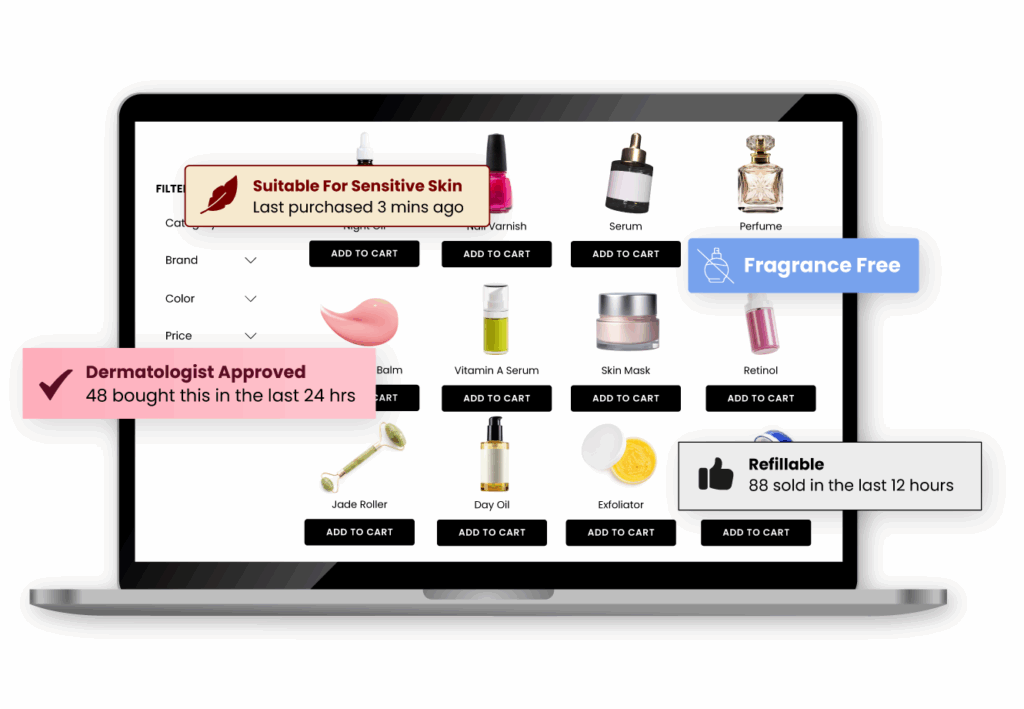
Taggstar’s Attribute Messaging accounts for this by surfacing the attributes most likely to resonate in each shopping context, rather than displaying the same information to every visitor. The result is a more relevant product experience that reduces friction and increases conversion across different audience segments
Common challenges with product attributes
Many retailers and brands struggle with implementing product attributes effectively due to challenges like inconsistent manufacturer information, data overload, and siloed systems. Without a consistent approach to product attribute tagging, manually entered attributes across teams or suppliers lead to duplication, missing fields, and inconsistent naming conventions, undermining search accuracy and customer confidence.
As product catalogs grow, managing thousands of attributes becomes overwhelming, especially without clear workflows or ownership.
Additionally, when product data is stored in disconnected systems such as spreadsheets or outdated CMS tools, it is nearly impossible to keep attributes current, accurate and consistent across all channels.
The commercial cost of these challenges compounds over time. Missing size attributes lead to inaccurate filtering, which pushes shoppers to results they did not intend to see — and to returns when the wrong item ships. Incomplete sustainability credentials mean eco-conscious shoppers cannot find products that match their values. These gaps are not just UX problems; they directly suppress conversion rates and increase return rates. For more on how smart product information reduces returns, see Reducing returns rates in 2026.
Attribute Messaging: The next step in optimizing eCommerce product pages
As more and more shoppers land directly on product pages from search engines and social media, the PDP has essentially become the front door to eCommerce. You only have moments to capture the attention of shoppers and keep them engaged. In fact, a recent study revealed that 47% of visitors bounce if they don’t immediately see key information on a retailer’s site, and 40% only view the top half of the page.
Powered by AI, Taggstar’s Attribute Messaging is designed to highlight essential product attributes directly within the shopping experience, above the fold, to capture attention fast, and help shoppers make more informed purchase decisions. Attribute Messaging allows retailers and brands to showcase key product features, including material, fit, sustainability and product benefits in clear and visually engaging messages throughout the eCommerce experience.
The product catalog merchandiser chat feature helps you automatically surface new attribute suggestions based on real shopper trends, even if the attributes are not already included in a retailer’s product data set.
Benefits of Attribute Messaging
- Enhanced Product Discovery by surfacing critical product information upfront
- Improved Decision-Making by providing clear attribute information, reducing uncertainty, and helping customers make more confident decisions
- Improved User Experience by streamlining access to important product details, retailers can minimise the need for extensive browsing, leading to a more efficient shopping journey
By combining Attribute Messaging with Social Proof Messaging, the outcome is even more powerful. The relevancy of product attributes and the power of social proof immediately draws shopper attention, improves trust and increases conversions.
Using product attributes to drive discovery and conversion
Well-tagged product attributes enhance discoverability and power the dynamic, personalised experiences that shoppers today expect. Retailers and brands should prioritise clear, consistent, and enriched product attributes to deliver the best customer experience possible, improve marketing ROI and increase conversions and revenue.
With the right tools and platforms, retailers can scale, optimize and increase conversions more efficiently and effectively. Solutions such as Attribute Messaging dynamically leverage product attributes to deliver engaging experiences that capture the attention of shoppers, reduces bounce rates and increases conversions.
Talk to our team about surfacing the right product attributes for your shoppers — book a demo.
Frequently Asked Questions on Product Attributes
What is a product attribute in eCommerce?
A product attribute is a specific characteristic or feature that describes a product, such as its size, colour, material, price, or sustainability credentials. In eCommerce, product attributes are used to power site search, filtering, and product pages, helping shoppers find, compare, and choose products that meet their needs. Attributes can be tangible (directly observable, like weight or dimensions) or intangible (non-physical qualities, like brand reputation or ethical sourcing status).
What is the difference between product attributes and product benefits?
Product attributes describe what a product is: its physical features, specifications, and measurable characteristics. Product benefits describe what the product does for the customer: the value or outcome the shopper experiences as a result of those attributes. For example, a raincoat’s attribute might be “waterproof Gore-Tex outer layer.” Its benefit is “keeps you dry in wet conditions.” Effective product pages communicate both, because attributes answer “what is this?” while benefits answer “why should I buy it?”
Why are product attributes important for eCommerce?
Product attributes directly affect how shoppers find and assess products. Accurate attributes improve search relevance, enable meaningful filtering, and give shoppers the information they need to make confident purchase decisions. When attributes are missing or inconsistent, the consequences are commercial: shoppers abandon pages, return the wrong products, and lose trust in the retailer. Research from Akeneo’s Evolution of the Modern Shopper report (2025) found that 66% of shoppers have abandoned a purchase due to missing or inaccurate product information.
What are examples of product attributes?
Tangible product attribute examples include size, colour, material, weight, dimensions, and technical specifications. Intangible product attribute examples include sustainability credentials, ethical sourcing status, brand heritage, suitability (e.g. “ideal for sensitive skin”), and customer ratings. In eCommerce, both types matter: tangible attributes support filtering and comparison, while intangible attributes build emotional confidence and trust.
How do you manage product attributes at scale?
Managing product attributes across a large or fast-changing catalogue typically requires a product information management (PIM) system to centralise data, maintain consistent naming conventions, and push accurate attributes to all channels simultaneously. Without a PIM or equivalent system, attributes are often maintained in spreadsheets or entered manually by multiple teams, leading to duplication, missing fields, and inconsistency. Taggstar’s Attribute Messaging works on top of existing product data to surface the most relevant attributes dynamically, even when the underlying data set is incomplete.
What is Attribute Messaging and how does it use product attributes?
Attribute Messaging is a Taggstar product that surfaces key product features, such as material, fit, sustainability credentials, and product benefits, as visually engaging messages directly on eCommerce product pages, above the fold. It is powered by AI and pulls from the retailer’s product data to highlight the attributes most likely to capture shopper attention and drive confident purchase decisions. By combining Attribute Messaging with Social Proof Messaging, retailers can surface both what other shoppers are doing and why the product itself is the right choice, increasing trust and conversion at the same moment.
What is the difference between product attributes and product variants?
Product attributes describe a product’s characteristics (material, sustainability status, brand origin). Product variants are the specific, purchasable versions of a product defined by a combination of key attributes, typically size and colour. For example, a shirt might have attributes including “100% cotton” and “machine washable.” Its variants are “Small / White,” “Small / Blue,” “Medium / White,” and so on. Attributes describe the product; variants define what the customer is actually adding to their basket.