

Social proof is the mechanism that provides the signals from others when shoppers cannot ask a friend for a recommendation or pick up a product in a store. It is one of the most studied and most consistently effective drivers of online purchase behavior.
TABLE OF CONTENTS
- What is social proof?
- What is social proof in marketing?
- Benefits of using social proof in your strategy
- Why social proof works
- Building an effective social proof strategy
- How to use social proof in marketing and eCommerce
- Types of social proof in marketing and eCommerce
- Common mistakes to avoid
- How to use social proof to boost sales and ROI
- Getting started with social proof
- What to look for in a social proof solution
- FAQs about social proof in marketing and eCommerce
What is social proof?
Social proofing is the psychological tendency for people to base their own decisions on the observed choices and behavior of others.
In eCommerce, it describes the use of real customer signals (reviews, ratings, purchase counts, live browsing data) to reduce uncertainty and guide shoppers toward confident purchase decisions.
The term is rooted in Robert Cialdini’s 1984 book Influence: The Psychology of Persuasion, in which he identified social proof as one of six principles of persuasion. Cialdini’s principle states that when people are uncertain about what to do, they look to others’ behavior to determine the correct course of action.
“Social proof is a psychological and social phenomenon in which people assume the actions of others in an attempt to reflect correct behavior for a given situation.” — Robert Cialdini, Influence: The Psychology of Persuasion (1984)
For a full glossary definition, see the Taggstar social proof glossary.
What is social proof in marketing and eCommerce?
Social proof in marketing and eCommerce leverages real-time actions and authentic customer behavior to provide reassurance and reduce perceived risk among potential customers.
It establishes credibility and builds confidence, ultimately paving the way to higher conversions as trust is effectively demonstrated. Common examples of social proof include:
- customer reviews and ratings
- customer testimonials
- celebrity and influencer endorsements
- real-time social proof messaging and more.
In eCommerce, social proof is extremely important, leading to more engaging customer experiences, higher online conversion rates, higher RPV and AOV, and reduced returns.
In this article, we delve deeper into why social proof works and how to create an effective social proof strategy to boost ROI.
To help you put this into action, this guide walks through the strategies, psychology, and best practices behind high-performing social proof campaigns. Whether you’re building from scratch or optimizing what you already have, each section is designed to be practical and directly applicable to your business.
Benefits of using social proof in your marketing and eCommerce strategy
Leveraging social proof strategically delivers compelling benefits, directly impacting sales and brand credibility:
- Enhanced Customer Satisfaction: Real customer experiences create genuine brand connections, boosting loyalty and repeat sales.
- Increased Trust & Credibility: Consumers trust brands validated by peers and experts, making them more likely to engage and purchase.
- Higher Conversion Rates and Sales: Social proof reduces decision fatigue, driving more confident buying decisions that result in higher conversions, AOV and RPV.
- Reduced Product Returns: Authentic feedback and visual proof help align customer expectations with reality.
Why social proof works
The psychology of social proof, first defined by Robert Cialdini, explains our tendency to mirror others’ actions – especially in uncertain situations.
In marketing, this principle underpins how brands build trust through customer behavior, expert endorsements, and real-time shopper activity. Cialdini’s research showed this is not a weakness in human reasoning but an efficient cognitive shortcut: if many other people chose a product, the probability is high that it is the right choice.
Social proof does not work by creating pressure. It works by reducing doubt. Shoppers who see that 47 other people are viewing a product, or that it has been a bestseller in the last 24 hours, receive information that makes a decision easier, not harder.
See how Taggstar customers use real-time social proof across the digital shopping experience: read the case studies
Why is social proof important in marketing
Social proof is important in marketing because it fosters trust and credibility among potential customers.
When individuals see others buying or endorsing a product or service, it reassures them that they are making a sound decision. This collective validation can significantly influence their purchasing behavior, as people often look to the experiences of others to guide their choices. It also taps into FOMO marketing (fear of missing out) – when shoppers see that a product is trending and many other people are interested, the shopper is more inclined to desire that product in fear of missing out.
Moreover, social proof can enhance a brand’s reputation and encourage customer loyalty. By showcasing testimonials, reviews, and user-generated content, businesses can create a sense of community and belonging. This not only strengthens the relationship between the brand and its audience but also helps to establish a reliable image in a competitive market.
It’s important to incorporate social proof marketing strategies to helps brands align behavioral psychology with digital marketing techniques, from influencer collaborations and social proof messaging to user-generated content.
When used strategically, social proof becomes a vital part of an integrated digital marketing and eCommerce strategy.
Building an effective social proof strategy
A successful social proof strategy combines psychology, data, and technology to create trust-driven customer journeys.
Start building your social proof strategy by identifying where customers feel uncertainty or hesitation. Then, integrate the right mix of reviews, ratings, and real-time social proof messaging to guide purchase decisions.
Leading eCommerce brands use Taggstar’s expertise to craft scalable social proof strategies that deliver measurable ROI across multiple channels — from website and app to email, social, and digital advertising.
When optimized correctly, your social proof approach evolves from a simple marketing tactic into a core part of your overall digital marketing and eCommerce strategy.
How to use social proof in marketing and eCommerce
There are several ways to incorporate social proof into your marketing and eCommerce activities to deliver more trustworthy and engaging customer experiences. By leveraging social proof to showcase what other people are buying from a site and highlighting that customers are happy with the products and services sold, most retailers and brands see immediate results, including higher online conversions, more engagement, fewer returns, increased AOV (average order value) and more.
To maximize results, build a social proof marketing strategy that aligns with your customer journey. Define your objectives – whether increasing conversions, reducing returns, or driving engagement – and choose the right mix of real-time messaging, reviews, and influencer content to achieve them.
Types of social proof in marketing and eCommerce
Social proof takes several forms in eCommerce. Each works through a different signal type and suits different points in the purchase journey.
1. The Wisdom of the Crowd
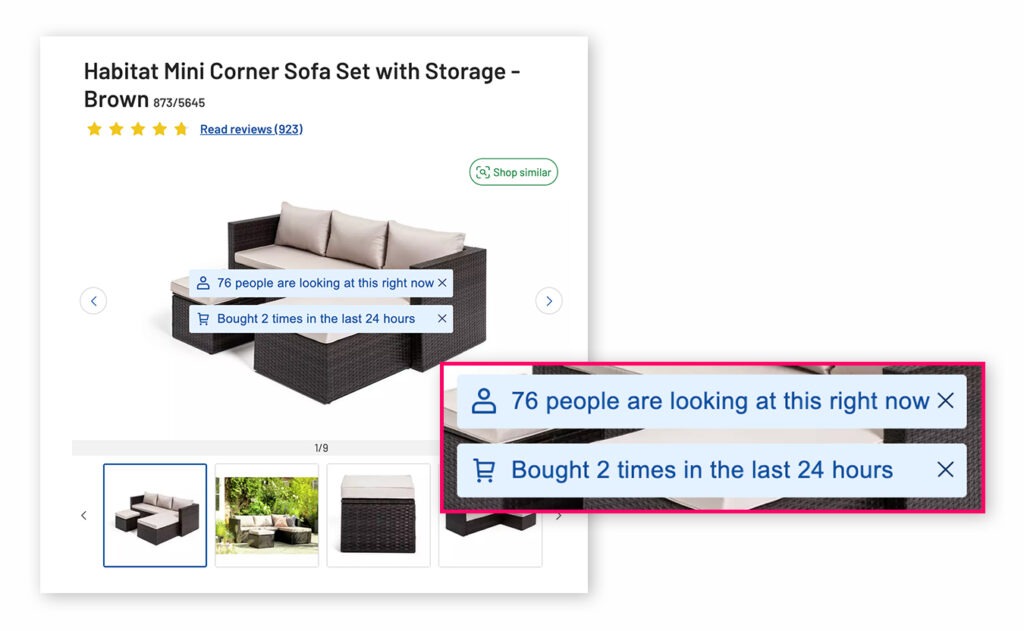
Social proof messaging pools the wisdom of the crowd to help customers with product discovery and to help make informed and confident purchasing decisions.
- Key Tips:
- Social proof messaging should always be based on real-time data – without this, you expose your brand to risk.
- Use simple, factual messages tailored to suit your brand tone of voice
- Ensure you can implement this technology across Product Listing Pages (PLPs), Product Description Pages (PDPs), Checkout Pages, Display Ads, Native App, Emails, Social Media, and Digital OOH
- Deploy A/B testing to rigorously test statistically significant uplifts
- Ensure artificial intelligence (AI) is built in as standard
2. User Generated Content / Shared Content
UGC or Shared Content is often referred to as ‘earned’ content. This may happen naturally, but there are very effective tactics you can employ to maximize UGC for your brand:
- Key Tips:
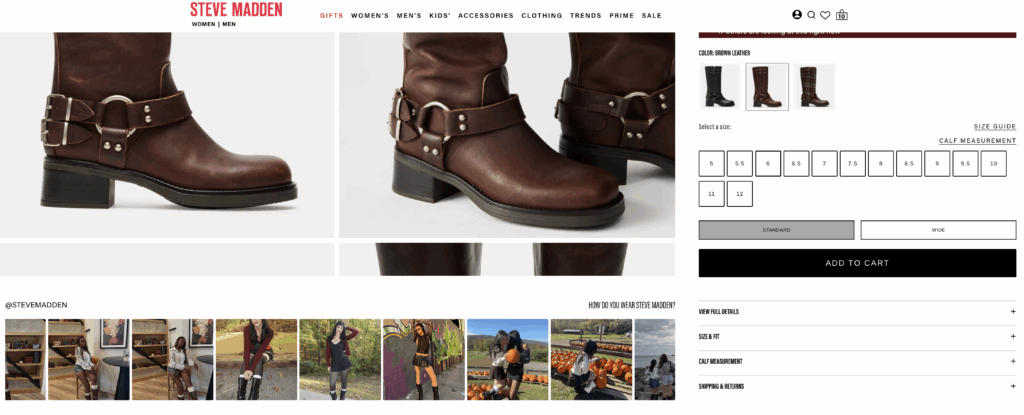
- Encourage customers to share photos of their recent purchase in return for discounts on their future purchase, prizes for the best content or even simply increased exposure. Using emails and leaflets with the items when delivered, are two easy ways to communicate this whilst encouraging customers to tag you and use your preferred hashtags for maximum exposure
- Reshare their content (with their permission!) on your main channel, ensuring you reciprocate the @. This shows your followers that if they share great content, they may get additional exposure for their own handle
- Share in your stories and link through to the product(s) being shown
EXAMPLE: This example from Steve Madden perfectly showcases how they’ve both encouraged UGC and woven it into their eCommerce site. cases how they’ve both encouraged UGC and woven it into their social media strategy.
3. Reviews, case studies, customer comments and testimonials
Consumers rely on other consumers to learn about products and often become (often unknowingly) brand advocates through user-generated content (UGC) like customer reviews, photos and Q&A.
- Key Tips
- Go deeper than ‘comments’ alone. Layer this with fit, quality, value, and which size and/or color variant the customer chose
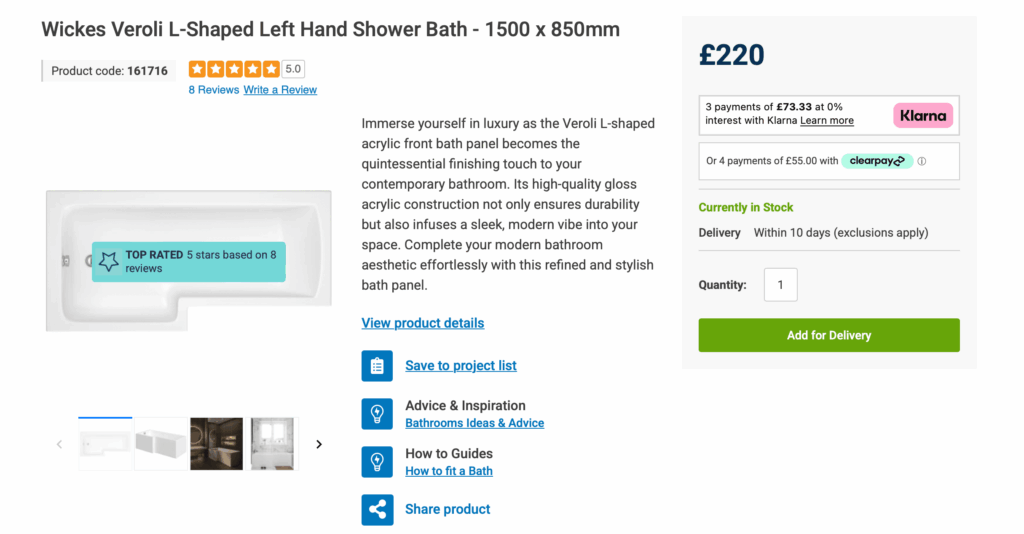
Reviews can be pulled into social proof messaging and deliver even greater ROI uplifts as seen in the example below from Wickes.
4. Influencer/celebrity endorsements
Influencer marketing has become a fundamental channel for many eCommerce brands. Not only can this help your brand reach new audiences, but it also helps align your brand and its values with those of their followers
- Key Tips:
- The influencer or celebrity’s own style and tone of voice should lead the content, rather than be led by your brand, to retain authenticity
- Developing new product lines in collaboration with influencers will deliver even greater authority
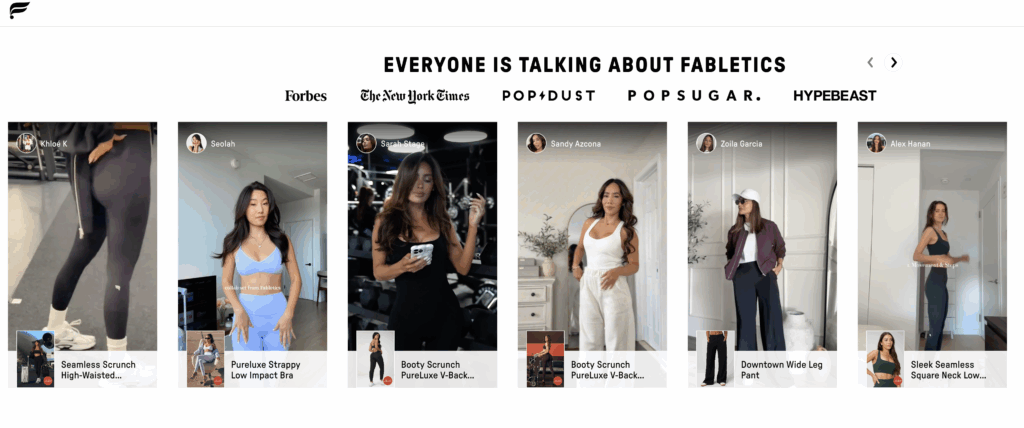
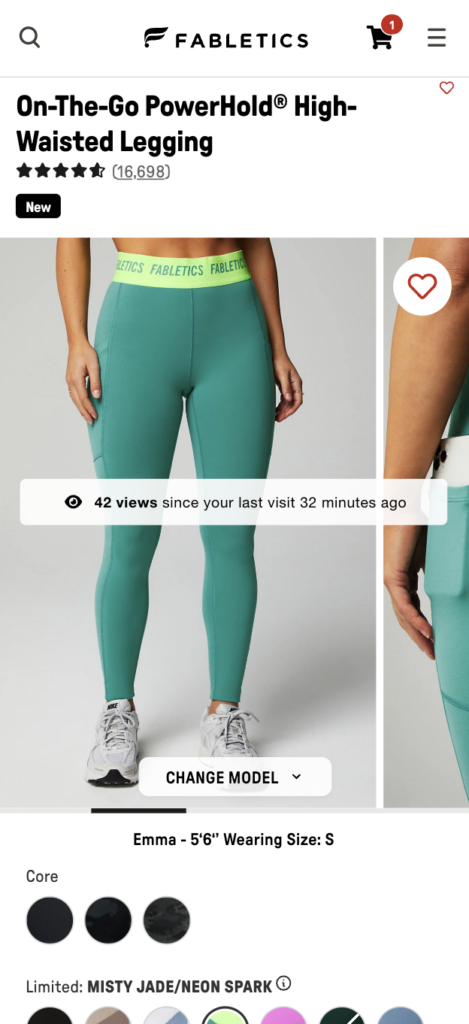
EXAMPLE: Fabletics has a network of influencers that they collaborate with and promote their content across Instagram, Tik Tok, their website and app.
5. Expert opinion, accreditations and third-party endorsements
Independent third-party accreditation provides consumers with a verified ‘stamp of approval’. This can be particularly powerful for items requiring a high investment
- Key Tips:
- Leverage existing partnerships and industry relationships. This could be in the form of awards you may have won, industry standards you’ve achieved and industry body reviews
- On social platforms, this can be as simple as having the verification symbol on your handle
6. Credentials
Almost all companies will have their own credentials that can be used to showcase authority and credibility, such as:
- the number of customers they have
- how many years they’ve been operating
- which countries they operate in
- how many items have been sold
- the number of reviews given
EXAMPLE: This example from Crew Clothing demonstrates this perfectly by aligning the years they’ve been established with timeless British style.

7. Real-time social proof messaging
Real-time social proof messaging is distinct from the other types because it draws on live shopper behavior data rather than historical records.
Messages such as “43 people are viewing this right now” or “This item has been added to 18 baskets in the last hour” reflect what is actually happening on the site at that moment. Without real-time data, the message is not genuine social proof. It is a copy of behavior, not a report of it. For more on how real-time messaging differs from standard product badging, see what is the difference between Social Proof Messaging and badging
8. Combining social proof techniques
These social proof tactics do not need to be used in isolation. By understanding which will be most important to your customers at each point of the buying journey, they can be combined to great effect.
Common mistakes to avoid in social proof marketing
Not all social proof signals help conversion.
Negative social proof occurs when messaging inadvertently normalizes unwanted behavior. A message like “Most shoppers leave without buying” would, in theory, increase abandonment by confirming it as the norm.
Responsible implementation means surfacing signals that reflect genuine positive activity, not manufacturing urgency or misrepresenting shopper behavior. Taggstar’s approach to responsible social proof is built around this principle. See Responsible Social Proof for full details on how Taggstar defines and applies these standards.
Avoid common pitfalls to ensure your social proof marketing remains authentic, compelling, and effective:
- Avoid Generic Testimonials: Specific, detailed testimonials resonate better with your audience and improve credibility.
- Never Fake It: Always use real-time data and genuine user experiences; transparency is key to maintaining trust.
- Don’t Overload or Misplace Social Proof: Strategically balance various forms of social proof across your marketing channels.
- Regular Updates are Essential: Continuously refresh your social proof to stay relevant and credible in consumers’ eyes.
How to use social proof to boost sales and ROI
Social proof delivers ROI when it is implemented with the right data, at the right point in the purchase journey, and measured against clear conversion metrics.
1. Start with the product detail page
The PDP is where most purchase decisions are won or lost. Social proof messaging at this stage, drawing on live views, basket adds, and purchase frequency, addresses the hesitation that causes abandonment.
Taggstar’s Social Proof Messaging integrates directly with eCommerce platforms, populating product pages with real-time signals from live shopper behavior.
2. Apply social proof to high-consideration or high-value products first
The conversion uplift from social proofing is proportionally greater for products where shoppers deliberate more: higher price points, multiple variants, and products without strong brand recognition. Start implementation here before rolling out across the full catalogue.
3. Use AI to ensure the right message is delivered at the right time
Taggstar’s AI-powered solution ensures that the right message is delivered at the right time in the purchase journey. Building on over a decade of experience and data, our platform uses AI neural networks to select the best messaging in real-time, continually optimizing for higher conversions.
4. Ensure the data is real
Social proofing loses credibility when shoppers suspect the signals are manufactured. Inflated view counts or fake purchase notifications carry legal and reputational risk. All Taggstar messaging draws from verified, live platform data.
5. Test, measure, and iterate
Social proof is not a one-off implementation. Message types, placement, and frequency should be tested against conversion rate, add-to-basket rate, and revenue per visitor. Taggstar customers typically see initial results within days of going live, with ongoing optimization producing compounding gains. For a detailed breakdown of ROI benchmarks, see what is the return on investment from Social Proof Messaging.
Talk to our team about social proof for your eCommerce store — book a demo
Getting started with social proof in marketing
Social proof can be woven into your eCommerce, digital and overall marketing strategy with almost immediate effect and deliver statistically significant ROI uplifts in a matter of weeks. Taggstar’s social proof solutions can help you take your real-time purchasing behavior to deliver consistent and measurable conversion rate uplifts from day one. Whether you’re building a social proof digital marketing campaign or refining your eCommerce and social proof approach, results can be tracked and optimized in real-time.
What to look for when selecting social proof messaging solutions for your business
The right solution enables brands to turn behavioral data into persuasive, real-time messaging – transforming social proof into a powerful ROI-driven marketing and eCommerce strategy.
- AI-powered social proof based on real-time data taken directly from the retail/brand’s own systems
- Simple, factual messages tailored to suit your brand tone of voice
- Platform-agnostic implementation that works across any eCommerce platform
- Multiple channel integration (e.g. website, social, display ads, native app, email, OOH)
- A/B testing to rigorously test statistically significant uplifts
- The ability to integrate different types of social proof to increase conversion rates
Boost conversions and drive sales with Taggstar’s social proof
At Taggstar, our experts have pioneered social proof technology, helping global eCommerce brands implement scalable social proof marketing and eCommerce strategies that deliver measurable results. Our social proof messaging solution integrates these tactics across the digital buying journey to deliver consistent and significant ROI uplifts.
Many leading retailers have already achieved measurable results with Taggstar’s social proof technology:
- Fabletics saw a 3.19% increase in conversions after integrating Taggstar’s social proof messaging across their site.
- Steve Madden reported a 5.41% uplift in conversion rates and stronger customer engagement.
- The Very Group achieved over a 15% improvement in conversion rates, demonstrating how consistent testing and optimization can drive ROI.
- Bloomingdale’s saw a 1.5% revenue per visit (RPV uplift) and a 1.6% conversion rate uplift on the initial POC after just two weeks. Beating expectations social proof messaging was implemented across web, mobile app and even emails, further boosting conversions and sales.
FAQs about social proof in marketing and eCommerce
Q1. What is real-time social proof?
Real-time social proof shows live shopper activity – such as “15 people bought this in the last hour.” It creates urgency, builds trust, and helps increase conversions in eCommerce environments.
Q2. What is social proof in marketing?
Social proof in marketing is the psychological phenomenon where consumers are influenced by the actions and opinions of others. This includes reviews, testimonials, influencer endorsements, and real-time customer activity. Using social proof strategically can increase trust, conversions, and engagement on your website.
Q3. What is a social proof strategy?
A social proof strategy is a structured approach to integrating credibility signals (like reviews or expert endorsements) across your marketing and eCommerce touchpoints to maximise ROI.
Q4. How can I use social proof in marketing?
Incorporate social proof across multiple channels—your website, emails, social media, display ads, and apps. Test different formats like trending products, reviews, and ratings. Taggstar’s platform helps you deliver these messages strategically to maximize conversions.
Q5. How does social proof impact eCommerce?
Social proof reassures online shoppers, reduces hesitation, and drives higher conversion rates – especially when powered by real-time data from platforms like Taggstar.
Q6. What are examples of social proof in digital marketing?
Examples include testimonials, influencer collaborations, user-generated content, expert endorsements, and real-time notifications that display live shopper activity.
Q7. What is social proof messaging software?
Social proof messaging software delivers real-time messages on eCommerce pages based on live shopper behavior data. Messages typically show how many people are currently viewing a product, how many have purchased it recently, or whether it is trending in a category. Taggstar’s Social Proof Messaging draws on live platform data to ensure every message reflects genuine shopper activity.
Q8. How do you measure the effectiveness of social proof?
The most direct measure is conversion rate uplift (CRU): the difference in conversion rate between product pages with social proof messaging and equivalent pages without it. Supporting metrics include add-to-basket rate, revenue per visitor (RPV), and bounce rate on product detail pages.
Q9. Is social proof legitimate, and are there any risks?
Social proofing is legitimate when it draws on real, verifiable data. The risk arises when signals are manufactured or exaggerated: inflated view counts, fake purchase notifications, or urgency claims that do not reflect actual shopper behavior. In the UK, this kind of fabrication falls under the UK Competition and Markets Authority (CMA) guidance on misleading urgency claims and can expose brands to regulatory and reputational risk. Taggstar’s platform uses only verified, real-time data from live shopper activity. For more on responsible implementation, see Taggstar’s Responsible Social Proof page.
Interested in social proof?
Get in contact today and one our social proof experts will be in touch